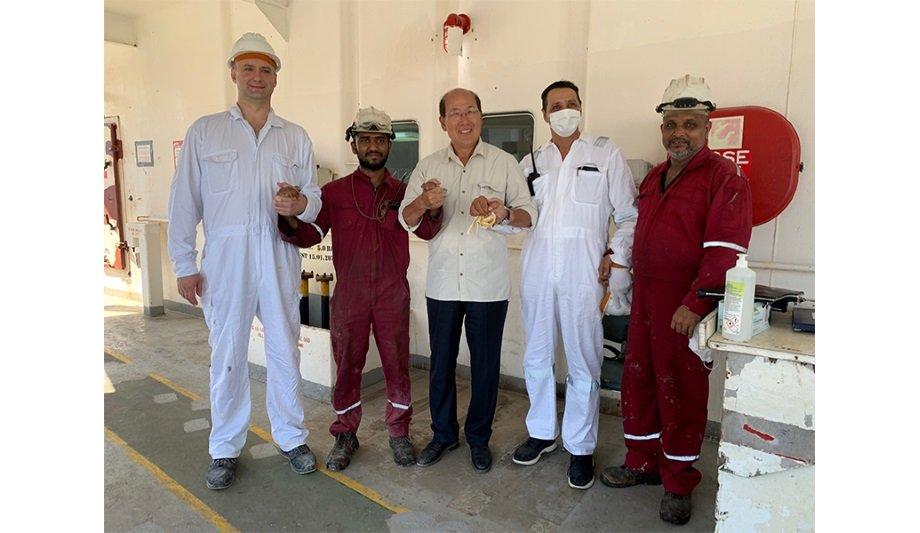

IMO Secretary-General Kitack Lim has highlighted the significant progress on the implementation of the Black Sea Grain Initiative and the critical role of seafarers in delivering global trade, during a visit to Odesa, Ukraine.
In Odesa, on Monday (29 August), Secretary-General Lim was able to gain first-hand experience of the Black Sea Grain Initiative and hear how ship safety and port management is being implemented.
Maritime humanitarian corridor
"I appreciate the UN and all other stakeholders for the establishment of the Black Sea Grain Initiative and its excellent implementation. The initiative has paved the way to allow significant volumes of grain exports to move from three key Ukrainian ports in the Black Sea," said Mr. Lim.
Secretary-General Lim boarded the MV Helga, one of the ships inspected under the Black Sea Grain Initiative and approved to journey to Odesa to pick up grains from Ukraine for export. “I am deeply appreciative to see the strong commitment of the seafarers to support the Initiative. The safety and well-being of seafarers is my top priority. I am pleased that the designated maritime humanitarian corridor under the initiative is allowing seafarers to do their job and deliver vital foodstuffs. IMO instruments, including the International Ship and Port Facility Security (ISPS) Code, underpin safe and secure shipping everywhere and especially through the Black Sea,” Mr. Lim said.
Global supply chains
The Black Sea Grain Initiative specifically allows for significant volumes of foodstuffs
The IMO Secretary-General was hosted by Mr. Oleksandr Kubrakov, Minister of Infrastructure in the Government of Ukraine and the two had a fruitful discussion during the visit. Since the start of the conflict in Ukraine, IMO’s priority has been to support the welfare of seafarers, recognizing that the need for international shipping to move freely and unhindered is critical to the continuous operation of global supply chains, for the benefit of all peoples of the world.
The Black Sea Grain Initiative specifically allows for significant volumes of foodstuffs. The Joint Coordination Centre has been established in Istanbul, with representatives from Ukraine, the Russian Federation, and Türkiye, under United Nations auspices, to coordinate the safe passage of ships of all flags.
Mandatory requirements pursuant
As of 1 September, the total tonnage of grain and other foodstuffs exported from the three Ukrainian ports is 1,677,396 metric tons. A total of 146 voyages (78 inbound and 68 outbound) have been enabled so far. IMO provided legal and technical expertise to the Joint Coordination Centre to initiate its work.
‘Procedures for Merchant Vessels’ engaged in the Initiative are mandatory requirements pursuant to IMO’s International Convention for the Safety of Life at Sea (SOLAS) Regulation XI-2/11 and the International Ship and Port Facility Security (ISPS) Code, Part A, section 4.2 and Part B, section 4.26, and as a condition of port entry or departure to or from the Ukrainian ports.