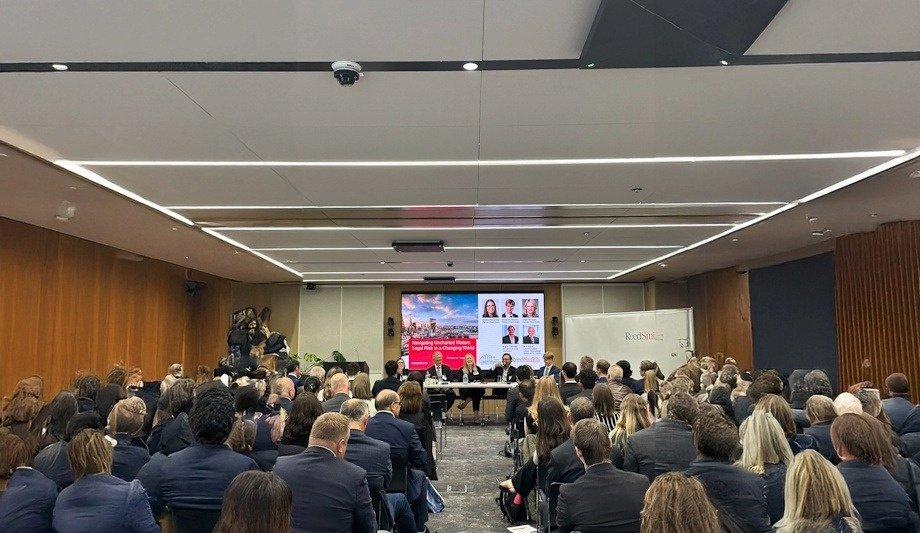

Global law firm Reed Smith hosted a breakfast seminar as part of London International Shipping Week (LISW), bringing together insurers, financiers, and other key stakeholders across the maritime industry.
The event, titled ‘Navigating Uncharted Waters: Legal Risk in a Changing World’s featured an interactive panel discussion by pioneering figures from the maritime and legal sectors. Speakers addressed critical challenges facing the shipping industry now, including international sanctions, tariffs and decarbonisation.
Immense pressure on the shipping sector
Chaired by Antonia Panayides, partner in Reed Smith’s Transportation Industry Group, the panel included Leigh Hansson, Global Regulatory Enforcement partner at Reed Smith; Alex Brandt, Transportation Industry Group partner at Reed Smith; Nick Shaw, CEO of the International Group of P&I Clubs; and Angus Galloway, Divisional Director at Clarksons.
Panayides opened the session by highlighting the immense pressure on the shipping sector to meet global decarbonisation targets. “With regulatory frameworks like CII, EU ETS, and FuelEU Maritime already in force, the industry now awaits October’s anticipated IMO Net Zero Framework. The fundamental question remains: how will the industry get to net zero—and who will pay for it?”
Evolving sanctions and tariffs landscape
The talk then shifted to the evolving sanctions and tariffs landscape, a major legal and operational risk
She added that underlying these environmental challenges is a fragile supply chain landscape, “Conflict-driven bottlenecks, port congestion, and labour shortages have exposed vulnerabilities,” said Panayides.
The conversation then shifted to the evolving sanctions and tariffs landscape, a major legal and operational risk for global shipping companies.
BIMCO drafting team
Reed Smith’s Brandt, who served on the BIMCO drafting team that developed the USTR Clause for Time Charter Parties 2025, discussed the clause, which was created to address the uncertainties and commercial implications of the U.S. Trade Representative's (USTR) fees on Chinese-linked vessels calling at U.S. ports.
“There was a clear need for the clause,” Brandt said, “The main question became: who carries the cost? It quickly became evident that charterers would bear much of the financial burden.”
Unpredictable impact of tariffs
Brandt also reflected on the unpredictable impact of tariffs—particularly U.S. measures—on trade flows
Brandt also reflected on the unpredictable impact of tariffs—particularly U.S. measures—on trade flows. “In Q2 of this year, the market nearly came to a standstill. There was a moment of realisation across the industry that the unpredictability of these sanctions could paralyse operations.”
Hansson delved into the growing challenges posed by the rapidly evolving sanctions landscape. She said: “The pace and complexity of sanctions in recent years has been unprecedented. For shipping companies, it’s not just about compliance, it’s about anticipating change. We get calls every hour from clients asking how to respond, especially around tariffs. But we’ve had to adopt a wait-and-see approach due to the high level of uncertainty.”
Commercial and operational perspectives
The session included contributions from Nick Shaw of the International Group of P&I Clubs and Angus Galloway of Clarksons, who offered commercial and operational perspectives on how shipping businesses can navigate legal, geopolitical, and environmental uncertainties.
The seminar underscored Reed Smith’s commitment to helping maritime clients stay ahead of fast-moving regulatory and market developments.